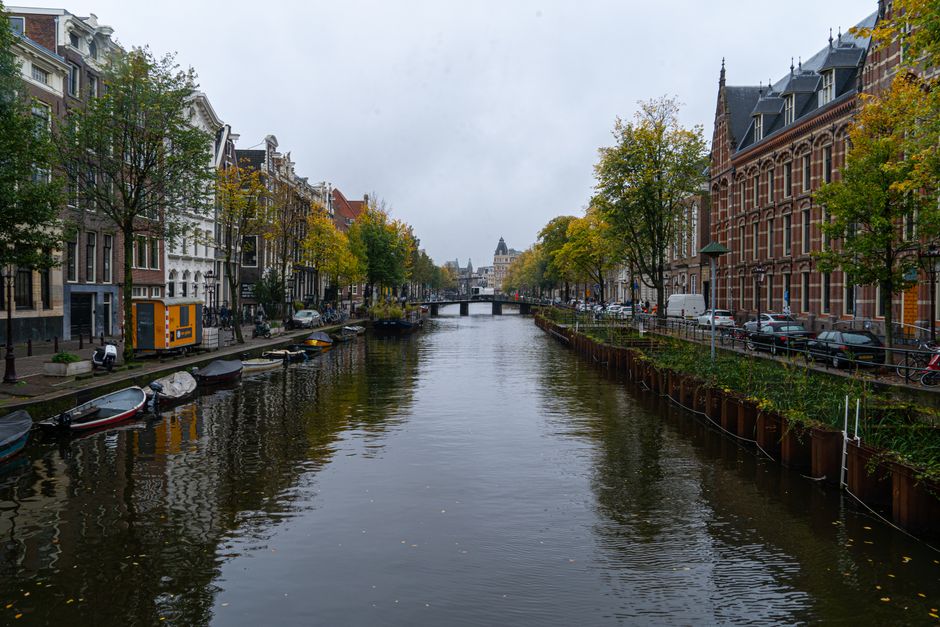
Amsterdam’s canals reward a little patience. Walk too quickly and the city becomes a sequence of bridges and narrow houses; slow down and you begin to notice reflections under an arch, a delivery arriving by the water, or the changing shape of a roofline. Seeing Amsterdam’s canals at a slower pace means choosing a manageable stretch, leaving room to pause, and accepting that you do not need to follow every attractive turning.
You can build a satisfying day around a walk and, if you wish, a boat trip. The aim is to spend time with the waterways rather than collect sights. A flexible route, comfortable shoes and a willingness to turn back are more useful than a packed itinerary.
Understand the shape of the canal belt
The central canal belt curves around Amsterdam’s older centre. Herengracht, Keizersgracht and Prinsengracht form its best-known concentric waterways, linked by streets and smaller canals. On a map, they offer an easy framework: follow one canal for a while, cross to another, then decide whether to continue or loop back.
Do not mistake that clear pattern for identical scenery. The width of the water, the scale of the houses and the amount of passing traffic change as you walk. Singel lies closer to the older centre, while Brouwersgracht meets the northern end of several central canals. Learning these names helps you navigate without having to keep a map open constantly.
Choose a small area for your first walk
Begin around Brouwersgracht
Brouwersgracht makes a useful starting area if you want bridges, former warehouses and long views along intersecting waterways. Start by looking down the canal from a bridge, then move onto the pavement before stopping for longer. The junctions are especially rewarding because you can see how the water routes connect.
From here, follow Prinsengracht south with the Jordaan on your right. You do not need to stay beside the water continuously. A short detour into the Jordaan’s streets provides a change of scale before you return to the canal. Keep these diversions small so the outing remains a stroll rather than an exercise in navigation.
Make a loop through the main canals
When you feel ready for a different view, use a connecting street to reach Keizersgracht or Herengracht and walk back in the opposite direction. This creates a flexible loop without requiring a distant finishing point. Look at the map before choosing your crossing: attractive streets can invite a longer detour than you intended.
The streets known collectively as the Nine Streets cross this part of the canal belt. They can bring more shoppers and foot traffic, so treat them as an optional diversion. If your chosen stretch feels crowded, move to a parallel canal or continue beyond the busiest crossing. A quieter experience often comes from a small adjustment rather than a journey to another neighbourhood.
Give yourself something to notice
A slow walk becomes more engaging when you look for details instead of another landmark. Compare the decorative gables along one block. Notice how some buildings meet the water with a narrow frontage while others occupy a broader plot. Look for hoisting beams near the roofs and the different shapes of bridges.
Houseboats add another layer to the scene, but they are also people’s homes. Enjoy the overall view without peering through windows, approaching private entrances or stepping onto access ramps. The same courtesy applies to canal-side houses: doorsteps and basement entrances are not public seating.
- Look along the water: bridge openings create changing frames as you move.
- Look upward: rooflines reveal differences that are easy to miss at street level.
- Look back: a familiar stretch can feel quite different from the opposite direction.
- Put the camera away occasionally: give yourself a stretch simply to observe.
Decide whether a boat trip suits your day
Being on the water changes your perspective. Bridges pass overhead, the lower parts of buildings become more prominent, and street traffic feels further away. A canal cruise can also give your feet a rest. However, boats differ in seating, shelter, commentary and boarding arrangements, so choose according to your comfort rather than the departure point alone.
Before booking, check the operator’s current route, departure location, accessibility information and cancellation terms. Confirm whether the boat is enclosed or open, whether seating is assigned, and where the trip finishes. A departure that fits naturally into your walk is more relaxing than rushing across the centre to meet it.
If you prefer quiet observation, look for clear information about commentary and the atmosphere onboard. Do not assume a smaller vessel will necessarily be quieter or easier to board. Ask about steps, handholds and space for mobility equipment when relevant. For a first visit focused on relaxing, a trip with a skipper also removes the need to navigate unfamiliar waterways yourself.
Plan around comfort, weather and daylight
Canal-side walking means stretches of exposure to wind and rain, and bridges add gentle climbs. Wear shoes with dependable grip and bring a layer you can put on while standing still. In wet weather, watch for slippery surfaces and puddles near the kerb. Leave room in your day for an indoor break rather than trying to walk through discomfort.
Daylight makes architectural details easier to see. Later, reflections and illuminated windows change the mood, but darker stretches require more attention to the water’s edge. Choose your walking time around the experience you want, then keep the route flexible. No particular hour guarantees empty streets, especially around popular sights.
Share the canal streets considerately
The canals are part of a working city. Pavements can narrow around parked bicycles, trees and entrances, while cycle traffic requires your attention at crossings. Check both directions before stepping off the pavement, and avoid stopping in a cycle lane to take a photograph. If you need to consult your phone, move somewhere that leaves a clear passage.
Many canal edges have no protective barrier. Give the water a comfortable margin, especially when taking photographs or walking with children. Keep bags close in crowded areas and arrange meeting points on dry, spacious ground rather than at the edge of a busy bridge.
Leave space for an unfinished afternoon
Before setting out, save an offline map and identify a convenient way back to your accommodation. Check current transport information with the official local transport provider and consult official city visitor information for access notices that could affect your plans. If a boat trip anchors the day, confirm its details directly with the operator.
Then give yourself permission to shorten the walk. You might spend longer watching the water near Brouwersgracht, settle into a sheltered break, or repeat a stretch whose light has changed. Amsterdam’s canals do not need to become a route you complete. A few waterways explored with attention can leave a stronger impression than an entire centre crossed in a hurry.