
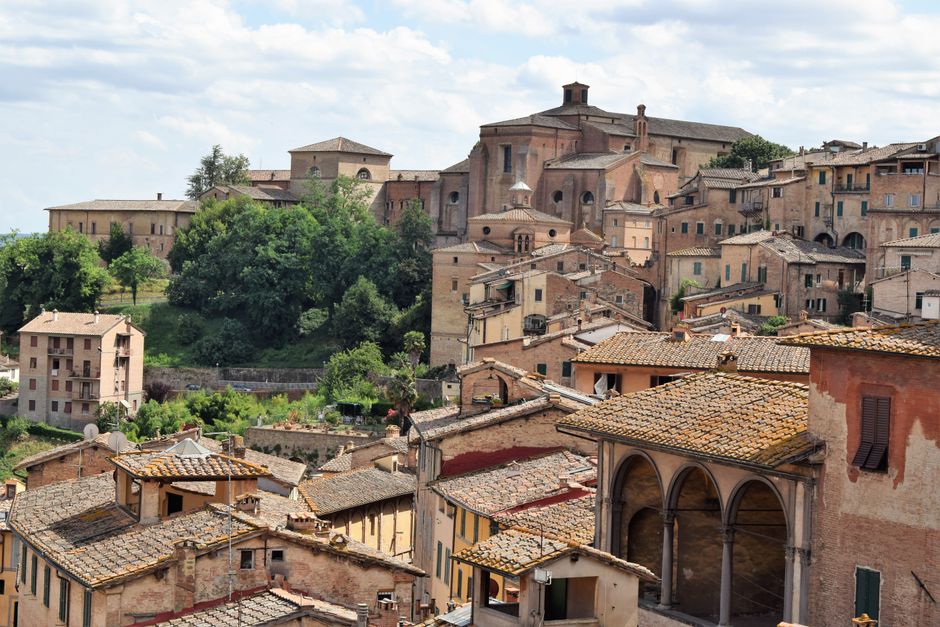
Siena rewards a day planned around a few places and the walks between them. Piazza del Campo gives you the city’s grand public face, while the cathedral, old hospital and quieter streets reveal different sides of its character. You can enjoy the essentials without racing through every museum or climbing every viewpoint. Start with the Campo, choose the interiors that interest you most, and leave room for lunch and a wander beyond the busiest lanes.
Plan your arrival around the hills
Siena’s historic centre is compact on a map, but slopes, steps and winding streets make walking more demanding than the distances suggest. Wear shoes with reliable grip, carry water and keep your bag light. In warm weather, build shaded breaks into the day; in rain, take extra care on polished paving.
The railway station sits below the old centre. An escalator route helps with the climb towards the Porta Camollia side of town, but you still have a walk before reaching the Campo. Follow local signs and check the official transport information before travelling, especially if you need a step-free route. Escalators should not be treated as an accessibility solution for everyone.
If you arrive by bus, check the exact stopping point rather than assuming all services finish in the same place. Drivers should use designated parking outside restricted streets and follow official access guidance. Save your arrival point on an offline map: the return journey feels easier when you know which gate or square you are aiming for.
Begin with Piazza del Campo
Approach the Campo through one of the narrow streets that open onto it. That sudden change from an enclosed lane to a broad, sloping square is part of its appeal. Walk around the upper edge first, then move towards the centre to appreciate the shell-like shape and the way the surrounding buildings frame the space.
The Palazzo Pubblico anchors the lower side, with the Torre del Mangia rising beside it. Fonte Gaia provides another focal point higher up the square. Give yourself time to look at the brickwork, windows and changing angles rather than treating the piazza as a single photograph. Keep entrances and walking routes clear when stopping.
Choose whether to go inside
The civic museum in the Palazzo Pubblico makes sense if paintings and the city’s civic identity interest you. The tower suits visitors who particularly want an elevated view and are comfortable with a demanding stair climb. You do not need both to appreciate the square. Check the municipality’s official visitor information for current access arrangements, restrictions and ticket requirements before committing your day to either.
The Campo also hosts the Palio, Siena’s traditional horse race. If your visit overlaps preparations or celebrations, barriers, crowds and access changes can reshape the experience. Consult official event information and allow more flexibility. An ordinary sightseeing route should not be assumed to work unchanged during major events.
Walk up to the cathedral
From the Campo, head towards Via di Città and continue towards Piazza del Duomo. This is a useful stretch to slow down: tall buildings, curved streets and small changes of level create views that are easy to miss if you follow your phone constantly. Step aside before checking directions and let residents pass through narrow sections.
The cathedral’s richly decorated facade invites a pause before you enter. Inside, striped stonework, sculpture and painted decoration compete for attention. Rather than trying to absorb every detail, choose a few features to study properly. A short visit with time to look can be more satisfying than a hurried circuit through an entire complex.
Check exactly what your admission includes. The cathedral complex contains several distinct visiting areas, and access to particular spaces or features can vary. Use the official cathedral operator’s information to confirm current arrangements and any reservation requirements. Dress respectfully for a religious building, with shoulders and knees covered, and follow instructions about photography and worship.
Make space for Santa Maria della Scala
Facing the cathedral, Santa Maria della Scala offers a different way into Siena’s story. The former hospital is now a museum complex, with spaces that reflect its long role in caring for people. It is especially rewarding if you are curious about how the city functioned beyond its grand churches and public square.
This is a substantial visit, so decide how it fits your interests. If the cathedral is your priority, give that your best attention and keep the hospital as an optional addition. If social history and atmospheric interiors appeal more, allow Santa Maria della Scala a larger share of the day. Check its official visitor information for available routes and exhibitions before you go.
Take a proper lunch break
Once you have finished your main interior visit, stop for lunch before starting another walk. Browse menus on surrounding streets and choose according to appetite, dietary needs and the kind of break you want. Read the displayed menu and ask about any charges before ordering, particularly when comparing a quick counter stop with a seated meal.
Local foods you may encounter include pici, thick strands of pasta, and sweets such as almond-based ricciarelli or spiced panforte. These make useful starting points for exploring Sienese cooking without turning lunch into a checklist. Ask about ingredients if you have allergies or dietary restrictions; a familiar dish name does not guarantee an identical recipe everywhere.
Spend the afternoon beyond the main sights
After lunch, choose one direction rather than crossing town repeatedly. For a straightforward continuation, return towards the main shopping streets around Banchi di Sopra and look into the smaller lanes branching away from them. Piazza Salimbeni provides a change of scene, with imposing buildings around a more contained public space.
Alternatively, walk towards San Domenico if you want another church and a different perspective on the city’s hills. Make this an unhurried extension, with time to turn back if your feet are tiring. Siena’s gradients can make a seemingly small detour feel substantial, particularly after museum visits spent standing.
As you wander, notice the symbols and flags associated with the contrade, Siena’s neighbourhood communities. They belong to an active local culture, not simply a decorative visitor trail. Respect private doorways and community spaces, and ask before photographing people closely. The streets are more interesting when you pay attention to everyday life as well as monuments.
Keep the last part of the day flexible
Return to the Campo if your departure allows it. Seeing the square again after exploring the rest of Siena gives its setting more meaning. You might notice a facade you missed earlier or simply enjoy a pause before the walk back. Leave enough energy for the slopes between the centre and your transport.
- For an art-focused day: prioritise the cathedral and one museum, with a shorter afternoon walk.
- For a mostly outdoor day: spend longer around the Campo, cathedral exterior and neighbourhood streets.
- For a gentler pace: skip tower climbs, choose fewer interiors and plan seated breaks.
Check your return connection with the official transport provider before settling into a final stop. Allow time to reach the correct station, stop or car park without rushing. A successful day in Siena leaves you with a sense of its spaces and rhythms, as well as memories of its most celebrated square.


