A train journey through the Swiss Alps works best when the railway shapes your holiday rather than simply connecting overnight stops. Lakes give way to wooded slopes, villages appear below high pastures, and tunnels open onto different valleys. The planning challenge is choosing which landscapes you want to linger over. Build your route around a few rewarding sections, leave space to step off the train, and treat the journey itself as part of each day’s sightseeing.
Choose a landscape before choosing a train
Start by deciding what you hope to see. For lakes, gentle mountain scenery and access to valley walks, consider central Switzerland and the Bernese Oberland. For dramatic railway engineering and a transition from high Alpine terrain to an Italian valley, look east towards Graubünden and the Bernina route. Trying to combine every celebrated line can leave you with repeated packing and little time outdoors.
Draw a simple route with your arrival point, departure point and two or three overnight bases. Then examine the railway geography between them. A compact journey with an afternoon beside a lake often feels more satisfying than an ambitious circuit spent watching the next connection approach on your phone.
Two routes with different rewards
Lucerne to Interlaken for lakes and valley access
The Luzern–Interlaken Express links Lucerne and Interlaken through a landscape of lakes and mountain slopes. It makes a useful backbone for a first Alpine rail holiday because both ends offer reasons to stay. In Lucerne, combine a waterfront walk with time in the old town. Around Interlaken, choose a valley excursion or lakeside outing that suits the weather and your walking ability.
Allow separate days for arrival, the scenic transfer and local exploring. You can extend your stay around the Bernese Oberland without changing accommodation every night. When researching onward travel, distinguish Interlaken Ost from Interlaken West: the appropriate station depends on your connection and where you are staying.
Chur through the Albula and Bernina landscapes
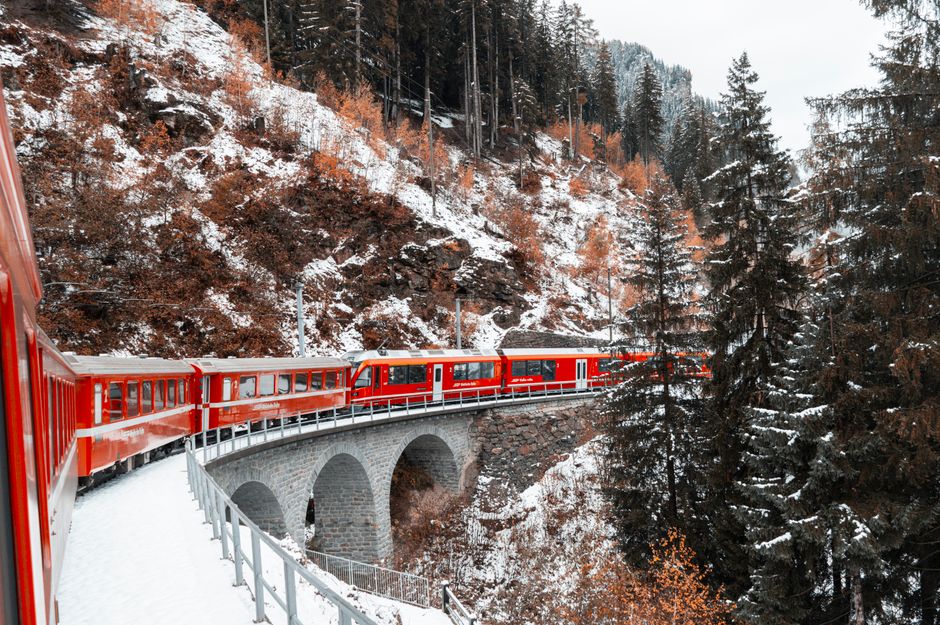
For a stronger sense of crossing the mountains, build a journey around Chur, the Engadin and Tirano. The Albula railway brings curves, tunnels and viaducts; the Bernina line continues through exposed high mountain scenery before descending towards Italy. Chur offers an old town to explore, while an overnight stop in the Engadin gives you time to experience the landscape beyond the carriage window.
Decide whether Tirano will be your endpoint, an overnight stop or the start of a return journey. It is in Italy, so carry the travel documents appropriate to your nationality and itinerary. Check the whole onward route before committing to accommodation, especially if you plan to continue beyond the Alps.
Keep scenic lines in your journey search
A journey planner generally prioritises getting you to your destination efficiently. That may mean a faster tunnel route instead of the mountain railway you wanted. Search using an intermediate station on your chosen scenic line, then inspect the individual legs. Save the full itinerary so that you can recognise the correct route when comparing alternatives.
Use the Swiss Federal Railways journey planner alongside the relevant railway operator’s official information. Check for engineering work and replacement transport near departure. If a particular landscape is the purpose of your trip, confirm that your selected service actually travels through it; a familiar destination name alone does not establish the route.
Choose between panoramic and regional services
A panoramic service can suit travellers who want a reserved place and a continuous sightseeing journey. Regional trains can be useful when your priority is stopping along the way. Where both serve the same railway, the landscape remains the attraction, although carriage design, stopping patterns and changes may differ.
Before buying, separate three questions: does your ticket cover the journey, does your train require a reservation, and does your chosen seat or service involve an additional charge? A rail pass and a seat reservation serve different purposes. Read the operator’s current conditions rather than assuming that a pass settles every part of the booking.
- Choose a continuous journey when you want an uninterrupted day looking out of the window.
- Choose stopping opportunities when a village walk or lakeside pause matters more than remaining on one train.
- Check reservation conditions before planning a spontaneous change of departure.
Build breathing room into each day
For every scenic transfer, allow time to reach the station, find your platform and settle your luggage. A technically possible connection may feel uncomfortable with children, heavy bags or unfamiliar station layouts. When you have a choice, select a connection that leaves room for an ordinary delay or a slow walk between platforms.
Keep arrival days modest, especially after a flight. Sleeping near your first scenic departure can be easier than beginning with a complicated sequence of changes. On the final day, leave a generous margin before an international departure. Avoid making a distant mountain outing depend on everything running perfectly.
Match the season to your priorities
Snow transforms the railway landscape, but shorter daylight limits how much scenery you can see during a long journey. Plan your most important mountain section for daylight. In warmer months, longer days create more room for walking, although snow can remain on high paths even when valleys look green.
Spring and autumn bring appealing contrasts, along with possible seasonal closures on mountain attractions. A railway journey and a summit excursion are separate plans: one operating does not guarantee the other is available. Check official operating information and local conditions before building your day around a cable car, mountain railway or high trail.
Budget around your actual route
Compare individual tickets with passes only after sketching your route. Include local excursions and any mountain transport you genuinely expect to use. Check coverage, discounts, reservation requirements and flexibility separately. A product that suits repeated travel days may offer less value if you spend most of your holiday walking from one base.
Accommodation location also affects the practical cost of a trip. Look at the walk from the station, the gradient and your likely arrival time. A room that appears convenient on a map may involve an awkward climb with luggage. Staying longer in fewer places can simplify both travel days and everyday decisions.
Pack for the carriage and the mountains
Use luggage you can lift and manage through a station without help. Keep a warm layer, waterproof jacket, water and a snack accessible. Store luggage in designated spaces and keep aisles clear. If you need step-free access or assistance, check arrangements with the operator in advance.
For photographs through glass, dark clothing can reduce reflections, and keeping your lens close to the window may help. The line curves and the view changes, so avoid worrying excessively about the perfect side. Leave yourself stretches without a camera: watching the landscape unfold is the reason to be here.
Leave one day open
A flexible day lets you respond to cloud, tiredness or a place you want to explore more slowly. Keep a lower-level walk or town visit as an alternative to a mountain excursion. Before setting out each morning, check official service updates and the local forecast. With a clear route and a little spare time, your Alpine rail holiday can feel like a journey through places, rather than a list of trains to catch.