Ghent’s medieval centre rewards a walk that leaves room for looking up, crossing bridges and changing direction. Towers rise above shopping streets, riverside facades reflect in the water, and a castle appears among the everyday movements of a working city. The main sights sit close enough together to explore on foot, but squeezing every interior into one visit can make the experience feel hurried. Build your day around the streets and waterways, then choose the monuments that most interest you.
Get your bearings before setting off
Think of the centre as a walk between three connected areas: the churches and Belfry, the Graslei and Korenlei waterfront, and Gravensteen with nearby Patershol. This gives your exploration a clear shape without making it rigid. You can begin at either end, although starting around St Bavo’s Cathedral makes sense if seeing its art is your priority.
Allow a full day for a comfortable introduction with a couple of indoor visits and a proper lunch. With less time, keep the walk and select one major interior. An overnight stay gives you the pleasure of returning to the waterfront after the busiest sightseeing period, without having to fit an evening stroll around a journey home.
Arriving from the station
If you arrive at Gent-Sint-Pieters, remember that the railway station is outside the medieval core. Decide whether you want to walk into town or use public transport before you arrive, especially with luggage. Check the current journey planner from the transport operator for routes and disruptions rather than relying on an old tram number in a saved itinerary.
Start with the cathedral and the three towers
St Bavo’s Cathedral is a useful first anchor. Its scale makes an immediate impression, but a visit also offers a quieter counterpoint to the streets outside. If you want to see the Ghent Altarpiece, plan that part deliberately: check the cathedral’s official visitor information for the relevant admission arrangements, reservations and access conditions.
Give the artwork your attention rather than treating it as something to tick off between photographs. Looking closely takes energy, so avoid pairing it with several other demanding interiors before lunch. Visitors whose interests lean more toward architecture can still build a satisfying morning around the cathedral area and the surrounding public spaces.
Continue toward the Belfry and St Nicholas’ Church. These landmarks form Ghent’s famous sequence of three towers, but they served different purposes. The Belfry represents civic authority, while the churches express religious life. Seeing them together helps you read the skyline as more than a collection of attractive spires.
Decide whether a tower visit suits you
A high viewpoint can help you understand the layout you are walking through. Before choosing the Belfry as an indoor stop, check current access information, including any stairs or lift limitations relevant to your group. If heights or enclosed spaces make you uncomfortable, keep your focus at street level; the route remains rewarding without a climb.
Use St Michael’s Bridge as your visual turning point
Make your way toward St Michael’s Bridge for a broad view of the historic centre. From here, the water, waterfront buildings and towers come together in a way that is harder to appreciate from the narrow streets. Pause to orient yourself before taking photographs, and leave space for people crossing the bridge.
This is also a good place to notice how the city’s different layers overlap. Medieval origins do not mean that every facade has survived untouched. Restorations and later changes are part of the streetscape. Enjoy the overall setting while resisting the temptation to label every decorative detail medieval simply because it looks old.
Walk both sides of the Graslei and Korenlei
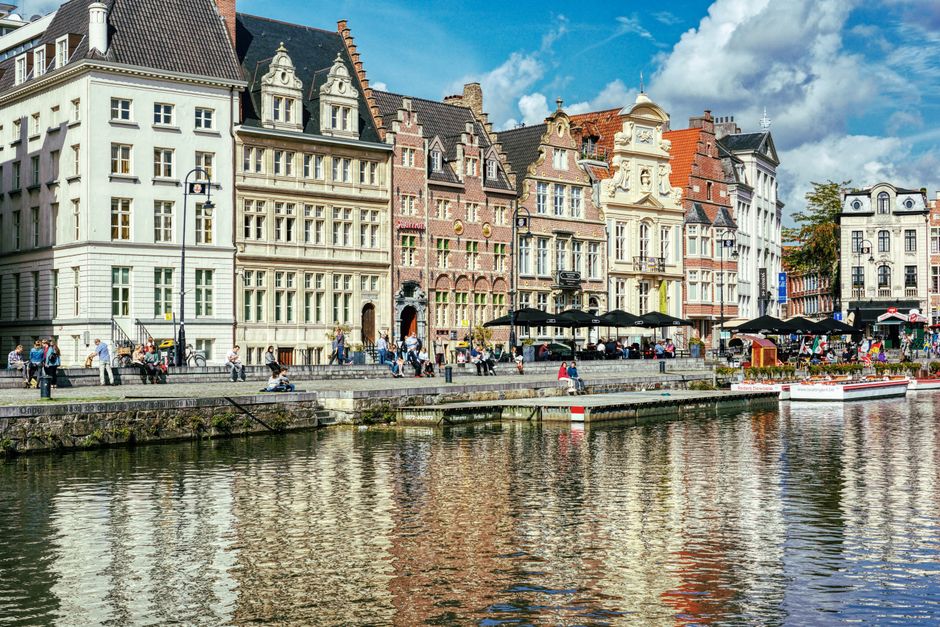
The Graslei and Korenlei face one another across the River Leie. Walk along one bank, cross, and return on the other to see how the facades change with your angle. Looking across the water often reveals rooflines and building proportions more clearly than standing directly beneath them.
The waterfront is worth exploring slowly. Choose a few details to follow: stepped gables, contrasting building widths, carved decoration or the relationship between doors and the quay. These small observations give the walk texture without requiring a guidebook entry for every house.
Take care near the water, particularly if paving is wet or you are walking with children. Riverside steps and uneven surfaces can interrupt an otherwise easy route. For a break, find somewhere that lets you sit comfortably rather than balancing food, bags and a camera on the edge of a busy passage.
Continue to Gravensteen and Patershol
Gravensteen, also called the Castle of the Counts, brings a different kind of presence to the centre. Its heavy stone walls contrast with the merchant streets and church towers. Even if you choose not to go inside, approaching the castle gives you a strong sense of how closely fortified power and urban life sit together here.
If you do visit, consult the official attraction information before booking. Check physical access and the nature of the displays, especially for children or anyone sensitive to material involving punishment. A castle visit can be engaging, but it should suit the people travelling with you rather than become an automatic stop.
Afterward, explore nearby Patershol. Its narrow streets invite a gentler pace and make a welcome change from the larger squares. Keep your wandering considerate: these are lived-in streets, so avoid blocking doorways, peering into homes or treating quiet corners as private photo sets.
Make the day comfortable in practice
Ghent is best enjoyed with enough flexibility to respond to weather and tired feet. Comfortable shoes matter more than an ambitious checklist. Pack a light waterproof layer, and make sure your phone has enough charge for navigation and any digital reservations. Download a map if you prefer not to depend on a connection.
- Choose your interiors: pick the cathedral artwork, the Belfry or the castle according to your interests, then add another only if you have time and energy.
- Leave room for lunch: read menus before sitting down and ask about dietary requirements instead of assuming a dish can be adapted.
- Watch for bicycles: stay aware when stepping into streets or stopping for photographs.
- Check accessibility separately: historic paving, steps and individual entrances can affect different parts of the same route.
Return to a favourite spot before leaving
Rather than finishing with a distant extra attraction, revisit somewhere you enjoyed. The waterfront may look different as the light changes, or a second pass through the tower district may reveal details you missed earlier. Keep your departure arrangements in mind and check current transport information with official sources. A little breathing space at the end lets Ghent remain a place you explored, rather than a route you rushed to complete.